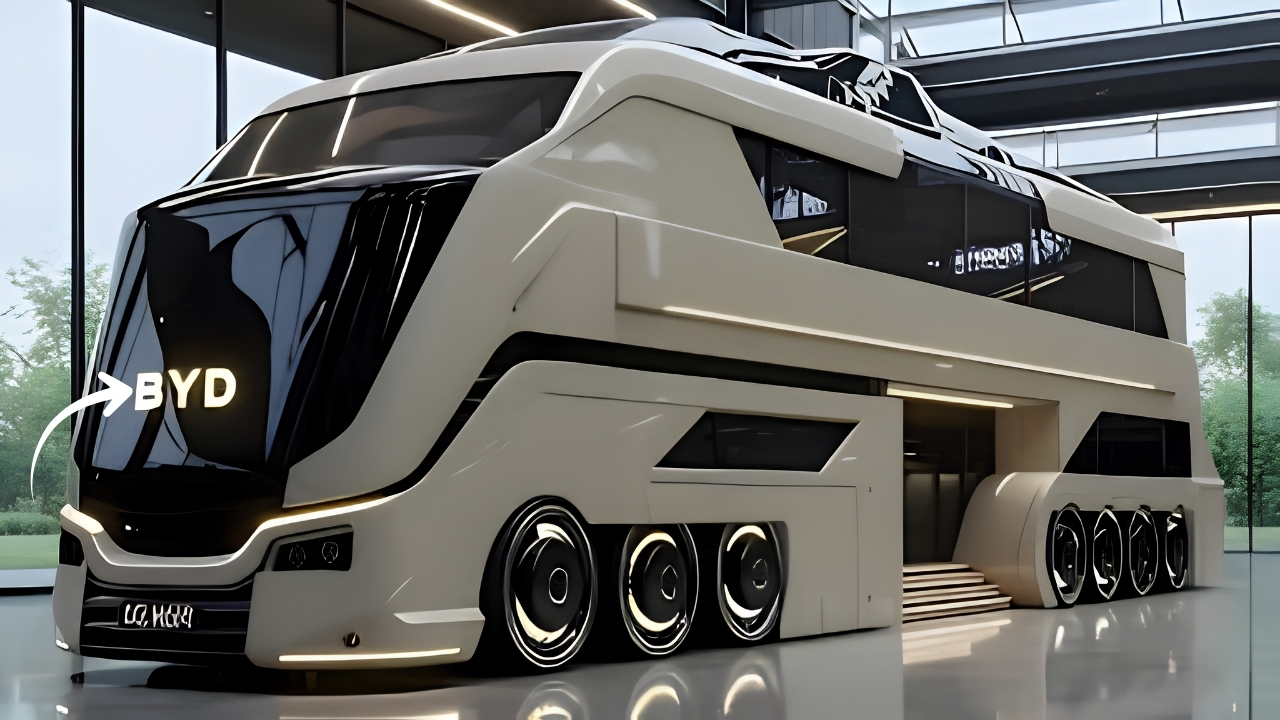
2026 BYD Motorhome : The idea of a 2026 BYD motorhome has generated plenty of excitement online, especially among American RV fans looking for quieter, more efficient alternatives to traditional gas- and diesel-powered rigs.
Videos and social posts describe futuristic electric campers with long driving range, solar-equipped roofs, high-tech cabins, and apartment-like interiors.
It is an appealing picture: an RV that can travel in near silence, power its living space from a large battery, and reduce dependence on fuel stations.
However, the most important update for U.S. readers is simple: there is no confirmed, official BYD-branded 2026 motorhome announced for sale in the United States.
Many circulating “2026 BYD Motorhome” articles and videos blend concepts, speculation, computer-generated imagery, and unverified claims.
One prominent video carrying the title explicitly states that the vehicle, specifications, availability, and images may be speculative rather than a real production model.
That does not mean the broader story is false. BYD is a major force in electric vehicles, batteries, buses, and commercial transportation, and motorhomes built on BYD-related platforms are becoming a real topic overseas.
The more accurate story is not that a BYD RV is about to arrive at every American dealership, but that Chinese electrified RV development is beginning to show what the next stage of recreational travel could look like.
The Real RV Development
A more concrete example comes from Wanaka, a Chinese motorhome brand that has introduced a six-meter camper based on the BYD T5DM hybrid chassis.
This is not the same thing as a factory-built “BYD Motorhome” sold under BYD’s own retail brand. Still, it matters because it shows BYD technology being used as a foundation for a purpose-built recreational vehicle.
The Wanaka model combines a hybrid driving system with a substantial off-grid living setup. Reports describe rooftop solar panels rated at 2,380 watts, an electric-only driving range of around 150 kilometers under the CLTC testing cycle, and a claimed combined range that can stretch much farther when the hybrid system is used.
The motorhome is designed for two people and reflects a trend gaining momentum in China: using electrified commercial platforms to build vehicles that can function as both transportation and self-contained living spaces.
For American RV shoppers, the significance is larger than the individual model. Traditional U.S. motorhomes usually separate the engine, generator, coach batteries, propane appliances, and house systems into different mechanical layers.
New electrified designs aim to integrate them more closely. Solar power, larger battery storage, electric cooking, connected controls, and hybrid propulsion can make an RV feel less like a converted truck and more like a mobile energy system.
Why Electric RVs Are Difficult
The excitement around electric motorhomes is understandable, but the engineering challenge is substantial. A motorhome is much heavier and less aerodynamic than a passenger car.
It may carry fresh water, waste tanks, furniture, food, passengers, bicycles, and camping equipment. It also consumes significant energy when running air conditioning, heat, refrigeration, induction cooking, lighting, and electronics.
That weight and energy demand make realistic range especially important. Claims of hundreds of miles of all-electric highway driving should be treated carefully unless they come directly from a manufacturer and include battery capacity, vehicle weight, test procedure, speed, terrain, weather conditions, and payload. Towing, climbing grades, extreme temperatures, and a fully loaded cabin can all reduce range sharply.
Charging is another challenge in the United States. Passenger EV charging has expanded rapidly, but many charging sites are not designed for a long Class A, Class C, or large camper-style vehicle.
Tight turns, short parking bays, blocked access, and the need to disconnect a towed vehicle can make road-trip charging inconvenient.
An electric RV could work especially well for shorter routes, campground stays, regional travel, and planned itineraries, but cross-country use would require stronger charging infrastructure designed around larger vehicles.
This is why hybrid RV platforms may arrive sooner than fully electric motorhomes for many buyers. A plug-in hybrid system can enable quiet electric driving near cities and campgrounds while retaining an onboard engine for long-distance travel, mountain routes, or areas with limited charging access.
What It Could Mean for America
If BYD or a partner eventually brings an electrified motorhome to the U.S., the biggest disruption may come from the living experience rather than straight-line performance.
A large battery bank and solar system could reduce the need for a noisy portable generator. Electric climate control and induction cooking could help move RVs away from propane-heavy designs. Smartphone monitoring could give owners more visibility into battery status, water use, cabin temperature, charging, and security.
The potential appeal is especially strong for remote workers, weekend travelers, and full-time RV owners who spend long periods parked rather than constantly driving.
For them, the question is not only how far the vehicle can travel on a charge. It is also how long it can remain comfortable and functional while parked away from shore power.
Still, buyers should avoid treating viral content as a product announcement. Some online descriptions have claimed radically different battery sizes, performance figures, prices, launch dates, and U.S. dealer plans.
That inconsistency is itself a warning sign. For now, no official U.S. BYD motorhome launch, specifications, retail network, or delivery schedule has been firmly established through reliable manufacturer information.
The Bottom Line 2026 BYD Motorhome
The 2026 BYD motorhome story is best understood as a glimpse of an emerging electrified RV future, not as confirmation that Americans can order a specific BYD RV today.
Real developments, including the Wanaka motorhome on a BYD T5DM hybrid chassis, show that the technology is moving beyond imagination and into actual vehicle design overseas.
Also Read this – 2026 Toyota Corolla Pickup launched with 4X4 full engine power, interior is fully luxury in low price
For U.S. consumers, the most realistic near-term expectation is likely a gradual move toward hybrid motorhomes, larger onboard batteries, solar-supported house systems, electric appliances, and smarter energy management.
A fully electric long-range motorhome may eventually become practical, but it will depend on battery advances, vehicle weight, charging access, and infrastructure built for RV-sized vehicles.