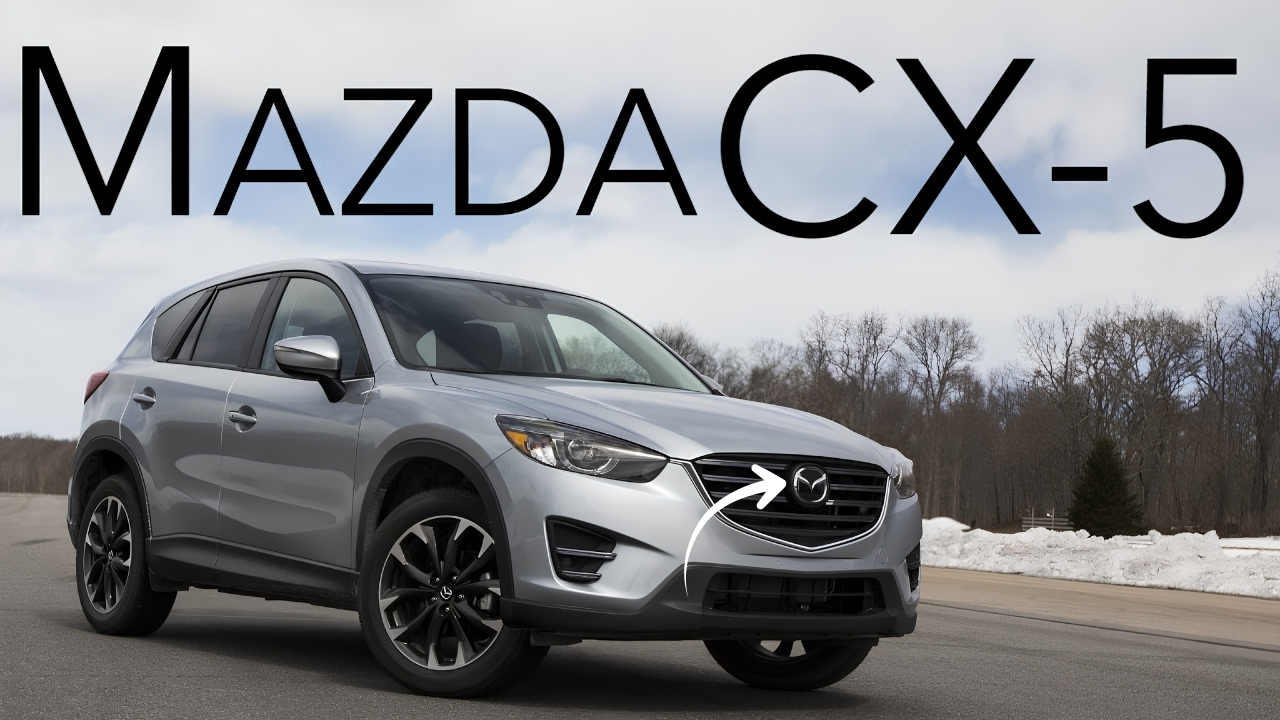
2016 Mazda CX-5 : The 2016 Mazda CX-5 arrived at a time when compact SUVs were quickly becoming America’s preferred family vehicle.
Buyers wanted room for children, groceries, weekend luggage, and all-weather confidence, but many models in the segment felt more practical than enjoyable.
Mazda’s approach was different: the CX-5 was designed to provide the usefulness of a crossover without abandoning responsive steering, balanced handling, and a driver-focused personality.
For U.S. drivers looking back at the 2016 model today, the CX-5 remains notable for its efficient engines, flexible interior, and above-average road manners.
It was not the largest or most powerful compact SUV on the market, but it stood out by making daily driving feel less routine.
A More Refined CX-5
The 2016 CX-5 built on the early success of Mazda’s compact crossover formula. Mazda gave the vehicle updated styling details, a more polished cabin, and additional technology intended to make it more competitive against popular rivals such as the Honda CR-V, Toyota RAV4, Ford Escape, and Nissan Rogue.
From the outside, the CX-5 had a clean, athletic look rather than the boxy shape common in many small SUVs. Its narrow headlights, sculpted body lines, and prominent grille gave it an upscale appearance.
It looked like a vehicle designed for drivers who still enjoyed the road, even if their priorities had shifted toward family duties and cargo space.
Inside, Mazda focused on improving the sense of quality. The dashboard layout was straightforward, controls were placed within easy reach, and higher trim levels added materials that made the cabin feel more premium than many shoppers expected in this class.
The design did not try to overwhelm drivers with buttons or complicated menus. Instead, the CX-5 aimed for a simple, driver-centered environment.
Engines and Everyday Performance
The 2016 Mazda CX-5 was offered with two four-cylinder engine choices. The base Sport model could be equipped with a 2.0-liter engine rated at 155 horsepower, while most versions used a stronger 2.5-liter four-cylinder producing 184 horsepower and 185 pound-feet of torque.
The larger engine was paired with a six-speed automatic transmission and was available with either front-wheel drive or all-wheel drive.
The 2.5-liter engine became the more appealing choice for many American buyers because it offered better passing power and more confidence when carrying passengers or cargo.
It was not intended to turn the CX-5 into a performance SUV, but it provided enough response for highway merging, city traffic, and long trips.
Where the CX-5 truly separated itself was in its driving feel. Many compact crossovers were tuned mainly for comfort and convenience, while Mazda gave this vehicle accurate steering and a chassis that felt composed through curves.
Car and Driver praised the model’s steering and upgraded interior, highlighting the CX-5’s continual refinement.
That personality mattered. A parent commuting to work during the week and taking the family on a weekend road trip could have a practical SUV without accepting a dull driving experience. The CX-5 retained much of the connected feel associated with Mazda’s passenger cars.
Comfort, Cargo, and Technology
The CX-5 provided seating for five people across two rows. It was especially well suited to couples, small families, and drivers who wanted useful cargo space without moving up to a larger midsize SUV.
With the rear seats upright, the vehicle offered 34.1 cubic feet of cargo capacity. Folding the rear seats expanded that number to 64.8 cubic feet, giving owners space for larger items, travel gear, or home-improvement purchases.
The rear seat design made the cabin more versatile for ordinary life. Whether the task was carrying sports equipment, a stroller, or several suitcases, the CX-5 could adapt without feeling excessively large in a parking lot.
Technology also improved across the lineup. Depending on the trim, available features included Mazda Connect infotainment, a 7-inch touchscreen, Bluetooth connectivity, rearview camera assistance, keyless entry, push-button start, navigation, Bose audio, and a power moonroof.
Touring models added useful upgrades such as blind-spot monitoring and rear cross-traffic alert, while Grand Touring versions offered a more upscale feature set.motortrend+1
The infotainment system reflected the technology of its era. It was functional, but some drivers may find newer systems more polished and more familiar.
Buyers considering a used 2016 CX-5 should test the screen, controls, Bluetooth connection, camera, and audio functions before completing a purchase.
Safety and Buyer Considerations
Safety was an important part of the CX-5’s appeal. Standard protection included front airbags, front-side airbags, and side-curtain airbags covering both rows.
Available driver-assistance features included adaptive cruise control, forward-collision warning, automatic emergency braking, lane-departure warning, blind-spot monitoring, and automatic high beams, depending on trim and package selection.
The model earned strong marks in several crash evaluations. The Insurance Institute for Highway Safety gave the CX-5 its highest “Good” ratings in a number of crashworthiness categories, while the National Highway Traffic Safety Administration gave the vehicle a four-star overall safety rating.
Still, used-car shoppers should not assume every 2016 CX-5 has the same safety equipment. Many advanced features were optional, so a buyer should inspect the exact vehicle rather than relying only on the trim badge. A Grand Touring model with the right package can be equipped very differently from a base Sport model.
It is also important to check the vehicle identification number for open recalls before purchase. Mazda has identified a recall affecting certain 2014 through 2016.5 CX-5 vehicles in which the fuel filler pipe could rupture during a rear collision, potentially allowing fuel leakage. Recall completion should be verified through Mazda or an authorized dealer.
Why the 2016 Mazda CX-5 Still Matters
The 2016 Mazda CX-5 remains a reminder that practical transportation does not have to feel anonymous. It combined compact-SUV usefulness with a driving character that helped it stand apart in a crowded U.S. market.
Its efficient four-cylinder engines, available all-wheel drive, generous cargo room, and available safety technology made it suitable for a wide range of drivers.
Its strongest quality was balance. The CX-5 did not claim to be the roomiest SUV, the fastest SUV, or the most luxurious SUV in its class.
Also Read this – 2026 Toyota Corolla Pickup launched with 4X4 full engine power, interior is fully luxury in low price
Instead, it offered a thoughtful blend of comfort, efficiency, technology, and responsive handling. For buyers who value a crossover that feels engaging behind the wheel, the 2016 Mazda CX-5 remains one of the more memorable choices from its generation.